Difference–sustaining–rupture–integration. Difference*
*This text presents a demonstration of a mechanism of formalization, which makes it necessary to clarify a set of foundational terms in order to prevent possible misreadings. The terms used here serve to designate operations and do not belong, in the strict sense, to philosophical, psychoanalytic, or mathematical discourse. Here, “difference” does not refer to a substantive difference between positions, but to an initial asymmetry arising within a given topology, which can be said to take place only retroactively, through the sustaining of form. Rupture does not constitute a new difference, nor an “intensification” of difference; it indicates a change of topology when the previous class of topological invariants can no longer be sustained. Integration does not eliminate the rupture, but fixes a new topological regime in which the sustaining of difference once again becomes possible. The text does not describe a subject; instead, by removing agency from it, it proposes an operation through which the subject emerges as an effect of the sustaining of difference, and demonstrates a possible transformation of operational topology. Reading difference as content, and rupture as an event, would be incorrect. The logical formalization of the operation is introduced as a retroactive fixation of the rupture and as the beginning of its integration, through an indication of the reproducibility of the operation, and functions as a way to sustain the operation without an object and without a guarantor.
In the present situation, where institutional forms of psychoanalytic discourse have become ineffective, the question can no longer be posed solely in terms of a loss of foundations or an ontology of immanent crisis. What becomes apparent here is the necessity of an operational shift: how the psychoanalytic procedure itself is reproduced, and on what basis its functioning is possible at all.
Established institutional and theoretical mechanisms continue to operate, yet they no longer produce difference, revealing the exhaustion of a regime in which rupture and remainder were held as an exceptional value. Psychoanalysis is defined predominantly in an apophatic mode, rather than through the conditions that make its own functioning possible. In the absence of any account of the operation, or of what psychoanalysis actually produces, its mode of functioning remains opaque, and reproducibility is reduced to the mere preservation of form.
Historically, the functioning of psychoanalysis as a method was guaranteed through the figure and the name of the analyst. This guarantee made transference operative as an address to the Other occupying the position of the one presumed to know and to be constituted by lack. The very possibility of transference was structurally bound to the way analytic discourse operated. The effectiveness of Freud’s and Lacan’s speech did not lie in providing guarantees or reassurance, a mode characteristic rather of university discourse and, more specifically, of scientific discourse grounded in the verification of content. It operated instead through certitude, which designates the moment at which the sustaining of difference becomes operative again within a new topology, what Lacan referred to as effet de vérité: truth appears not as content, but as structure
When the psychoanalyst comes to function primarily as a representative of an institution acting as guarantor, the address begins to shift toward the site of legitimation of analysis as such, and transference is formed not only toward the analyst, but also toward the institution, which operates through assurance. For this reason, the analysand increasingly demands reassurance in the form of verification of results, which replaces the formation of transference. The psychoanalytic clinic, understood as a practice that does not rely on institutional guaranteeing, continues to hystericize, since its logic is tied to the production of the question and of rupture, whereas the institution, by assuming the function of guarantor, produces psychotizing effects. The contemporary situation is further complicated by the fact that the analysand is informed not only about psychoanalysis as a theory, but also about internal institutional conflicts, making it impossible to exclude this awareness from the analytic situation. As a result, the very possibility of guarantee is undermined, since the institution itself repeatedly produces effects that, for the analysand, appear as remaining unanalyzed. When the institution becomes compromised in this way, the turn toward formalization emerges as a compelled reorientation of transference toward the operation itself and toward the difference reproduced by that operation, thereby restoring a regime of certitude.
The formalization of the operation as a reproducible procedure structurally calls into question the very foundation of the institutional regime of psychoanalysis. The institution has an interest in preserving monopoly and form around a “non-formalized remainder,” since this configuration functions as its capital and allows it to justify its own necessity by positioning itself as the sole custodian of the scene in which rupture is declared possible. Once rupture shifts from the status of an exclusive value to that of an effect of a procedure, the institutional superstructure occupying the place of guarantee begins to appear superfluous.
Attempts to apply psychoanalysis in art history, activism, philosophy, and politics are not singular and, to a large extent, shape the contemporary landscape. Yet most such practices operate in a mode of excess: they extend the range in which psychoanalytic language circulates, while allowing it to function only as an interpretative resource or as a marker of the radicality of a critical position. Such practices are most often scenographic and preserve psychoanalysis as a distinct cultural object to which one may appeal. In this way, they merely reinforce its autonomy, even when they present themselves as attempts to move beyond the classical institutional framework; they therefore remain at the level of theoretical content. Formalization, by contrast, makes it possible to shift the focus away from psychoanalysis as a privileged form of knowledge toward psychoanalysis considered through the conditions of its own operation, that is, through the reproducibility of the act.
The moment for such a structural turn is crucial and cannot be introduced arbitrarily. The issue is not one of historical perspective, since what is at stake is not linear progress, but the saturation of the field to the point at which repetition of the method no longer produces difference and alters nothing except scale. Without sufficient saturation, any formalization appears as just another proposal rather than as a necessity—one that emerges not as a “better solution,” but solely because the previous mechanism has ceased to produce difference.
1. Unfixed resistance
Despite the absence of any radical conflict or clear mistranslation between psychoanalytic and scientific discourse, one can identify a moment in which a difference was introduced into the field, while the resistance that followed remained unrecognized. This concerns the period in which Lacan introduced mathematical and formalized notations as an operational gesture, which can also be understood as a potential corrosion of the imaginary wholeness of scientific knowledge, with mathematical constructions appearing not as metaphors for explanation but as obstacles and as a means of producing anxiety.
An operational gesture, understood as a form of sustaining difference, can introduce a shift that destabilizes the stability of a structure. When difference is sustained, it is accompanied by tension that draws the structure out of automatic compensation through previously available means. Once this tension reaches its limit, as an effect of structural saturation, the structure changes in order to sustain another possible stable form through integration. Rupture then appears retroactively, marking a turning point, but it does not constitute an event. In this sense, any gesture without rupture remains a local fluctuation, reprocessed within the existing regime of smoothing, the analogue of which in Freud is the pleasure principle. When the structure enters a regime of stability, the sustaining of the next difference once again becomes operationally possible.
The reaction of scientific discourse was registered almost twenty-five years later, if one takes as reference the approximate dates of Lacan’s introduction of mathematical concepts in the early 1970s and the publication of Sokal and Bricmont’s Intellectual Impostures in 1997, and it was not addressed to Lacan alone. Under the heading of a generalized critique, intellectuals from different traditions and operating within different regimes in the use of scientific terminology were brought together; this work makes legible the resistance of the scientific field to the intrusion of the signifier, as the intrusion attempts to disrupt the boundaries of its formalized language. In this sense, the reaction is symptomatic, though with an important qualification. Within this reaction, fundamentally different regimes were flattened: Lacan’s gesture was placed on the same level as metaphorical and rhetorical borrowings found in a number of poststructuralist authors, cases in which criticism of science may indeed appear justified at the level of form. It is precisely this conflation of gesture and content that can be taken as decisive for what followed.
The psychoanalytic field, when confronted with such a reaction, does not read it as resistance. Rather than responding with interpretation, it responds with the defence of the scene and with closure, thereby missing the possibility of determining its own mode of operation within the shared field of critique. Any potential work with transference directed toward psychoanalysis from the side of science is suspended at that point.
It is notable that both sides were operating within a regime of anxiety and the scene. While science carries out its acting-out and then moves on, psychoanalysis offers no response and instead represses anxiety on its own side, and the repressed does not disappear without residue. At the same time the acting-out of science cannot be treated as something secondary: it emerges in response to an already accumulated tension that the psychoanalytic field had been unable to cope with for some time by that moment, not at the level of theory but that of position. Lacan makes a move, but it is not institutionally sustained, producing local disturbances within the analytic field, through which its anxiety becomes excessively exposed. Unable to deal with another’s anxiety due to the lack of an apparatus, science takes the only step available to it: it restores the boundary, returning everything to the coordinates of terminological rigor.
A quarter of a century later, this anxiety within the psychoanalytic field continues to be worked through: topology settles as an internal clinical instrument, losing the regime that Lacan established precisely as a gesture. (An example of such reworking can be found in Vappereau’s work, which incorporates scientific and topological references that have come to function more as ways of describing clinical phenomena than as a means of instituting an intervention in the field.) However, even now, it is still impossible to speak of a complete working-through of this anxiety. In some cases various myths and scientific concepts provoke such intense and affect-laden reactions within philosophical and psychoanalytic audiences, to the point that what emerges is read not as irritation or yet another unspoken myth, but as a protest directed at the signifier itself. Anxiety, therefore, has not been fully resolved, but redistributed and localized. Separately, the figure of Slavoj Žižek may be noted, as he frequently works at disciplinary boundaries and periodically turns to scientific phenomena at their intersection with psychoanalysis much as he approaches yet another film analysis. Žižek maintains the position of a subject of the scene, and as a result any gesture is read in advance as repetition and fails to produce a new effect. His interventions repeatedly receive the same response from representatives of scientific discourse, along the lines of “this has already been addressed,” indicating that an operational shift is highly unlikely to occur precisely through the maintenance of the scene.
Each of these described moves was possible under its own conditions, but the present situation calls not for new content, but for a change in logic (and above all in the logic of transference formation).
2. Logical formalization
When formalization is introduced not as a proposal for a new solution but as a compelled move arising from the impossibility of producing difference within the previous regime, it may initially appear trivial as a method. University discourse, and scientific discourse in particular, remains anchored in formalization as a method of legitimation, embedded in the phantasm of a signifying chain capable of closure without remainder—even when this phantasm is deferred or rendered more complex. Proof in science does not guarantee definitive truth; rather, it functions as a form of provisional stabilization of the field, recognized as valid within a given regime of rigor. Even fundamental mathematics and theoretical physics do not escape this general logic: a proof exists insofar as the conditions of symbolic operation have been satisfied (which is why proofs that once functioned as such become just another myth when the criterion of rigor shifts).
It is crucial to maintain the distinction between scientific discourse, where formalization operates through strict symbolic laws and where "proof" designates a reproducible operation within language, and "the discourse of science functioning in an ideological mode," where what appears as proof is in fact statistical aggregation of data or the exploitation of science as a master signifier. These regimes are structurally distinct: in the first case, the agent's position is occupied by a set of narratives, or S2, whereas in the second it is occupied by the master signifier S1—and this can no longer be described as scientific discourse. What is of interest here is the formalization employed by scientific discourse proper, not its disguised counterpart in the guise of the master’s discourse. Such formalization might be characterized as a means of provisionally altering the structure by which difference is sustained. This is the operative mechanism of what science calls "progress," though it is in no sense progress, since what occurs is merely the replacement of one narrative with another, given that science operates precisely with the object.
The master’s discourse spreads through a scene of legitimation, which is typical of the institution, whereas the capitalist discourse spreads through the formalization of method that renders it reproducible. The capitalist discourse operates by reassigning difference into lack, through the promise of an object capable of filling the proposed phantasm of wholeness by means of imaginary saturation (capitalism is an ontology of lack). Within this logic, the capitalist is not the one who extracts profit, but the one whose function is oriented toward extracting a remainder from the very lack that he himself generates. Thus, the university, capitalist, and master’s discourses each operate in their own way, yet each is directed toward the elimination of difference. The hysterical discourse stands apart precisely in that, by offering itself as the one who could fill the lack of the Other, the hysteric presents herself as an answer that never coincides in advance with the demand. In this sense, lack is not eliminated but kept in motion, exposing the inadequacy of any object, including the hysteric herself, and is used as an instrument of rupture in the Other. The hysterical discourse does not require institutional support, since the hysteric herself constructs the master, and this stability is always local.
Psychoanalytic discourse emerges as a response to the hysteric and initially exists as a local configuration, which ensures a strong attachment to the clinic and the scene. The shift occurs when the neurotic comes to occupy the central position of analysis—someone who arrives already acquainted with analysis, which happens because of the institution that guarantees analysis as both practice and knowledge. The neurotic brings not only transference onto their analyst, but transference onto analysis itself. In this process, the neurotic undergoes a process of hysterization within analysis, but now within an institutional contour. This is where the tension arises—psychoanalysis, while continuing to conceive of itself through hysterization, relies on an institution that "stabilizes and doses" this very hysterization. Against this configuration, the limitation of the clinical scene as the sole site where the operation works becomes visible. The clinic is now one mode of localizing and maintaining the operation, rather than its source—meaning the scene no longer coincides with the logical condition for the operation taking effect, but instead performs the function of a frame within which the operation can be recognized. Strictly speaking, the institution has never sustained anything beyond guaranteeing the scene itself. In other words, what's guaranteed is the right to consider something as working, not the actual working of the operation as such. As long as the operation fully coincided with the scene, this fiction functioned. However, once this split is made visible, it becomes clear that the institution guarantees neither the dosage, nor the effect, much less the outcome—it only regulates access to the scene within which an effect can be retroactively acknowledged.
At this point, the institution is left with two paths—either expanding and maintaining the significance of the scene through conflation with other domains, or abandoning the claim to guarantee and moving toward formalization of the operation. It is another matter that without a formalized operation and outcome, psychoanalysis is easier to "sell on the services market," but this ought not to be a problem for psychoanalysts.
2.1 Logical and scientific formalization
The difference between scientific formalization and the logical formalization of the operation under consideration here arises in its function:
In scientific discourse, formalization fixes a limit as a temporary site for the future capture of the unarticulated remainder (in Lacanian psychoanalysis—objet a), which remains within the logic of a horizon of result (as an object) that should be recognized by the institution and incorporated into the field. Thus scientific discourse sustains at its foundation the myth of the world's wholeness through the elimination of splits in symbolization. Despite the fact that in certain areas of physics, topology, and category theory, work proceeds not with objects but with relations and the impossibility of reduction, their orientation nevertheless remains toward the object. A topological space may be defined through relations of open sets, but the space is still conceived as that which "holds" these relations. Even when the remainder is formally acknowledged, it does not function as structure-forming.
Logical formalization of the operation is introduced not as an explanation or as its effect, but as an indication of the reproducibility of the operation in principle. Formalization in this case concerns exclusively the possibility of change in which there is no description of the subject's final configuration, but only the establishing that topological displacement is neither accidental nor dependent on the analyst's charisma, but possible as a sequence of operations, each of which may in itself guarantee nothing. Formalization here does not replace indeterminacy but, on the contrary, makes it structural—that is, it does not propose criteria for success but shows that indeterminacy is not a defect but rather its condition. What is at stake is not normative prescription or a certain guarantee, but the logical attainability of such a configuration being possible in principle (without the illusion of changing topology through a random or exceptional event). Of course, it should be kept in mind that formalization is sustained within the symbolic order of language, from which there is no "exit," and logic itself is its limit form, albeit the least compromised. The only reachable limit is bringing language to a configuration where it ceases to reproduce the imaginary and holds the split as the operation itself, and where difference ceases to function as content and becomes the mode of operation.
The institution of psychoanalysis, unlike the institution of science, does not protect a method of proof: the delivery of interpretation is not formalized and remains at the analyst's discretion, and conduct in the consulting room can vary depending on the school. Even Lacan's introduction of the short session does not cause the institution too much discomfort, translating such proposals into a different format of "portioning." What the psychoanalytic institution protects is the inviolability of the cut as value and the remainder as singularity of clinical cases. The cut here is always retrospective and bound to the scene—it is "produced" by interpretation, "sustained" in transference, and so on. Institutionally, it is not conceived as an operational effect that could be reproducible outside the clinic. By saying that "without the clinic this doesn't work" the institution puts forth precisely a boundary, not an argument.
One gets the impression that while acknowledging the changeability of the subject, the unconscious, even forms of jouissance, the psychoanalytic institution almost entirely excludes the possibility of changing its own operationality. Psychoanalysis, as a distinct discourse, has historically resorted to scientific and guarantee-based methods of integration into the field. Recently, this has been supplemented by a stake in public image, where the analyst, by presenting an identity, shifts the site of transference formation from analytic speech to imaginary fixation, offering himself not as an empty place of the cause of desire but as an object for identification. He borrows the entire infrastructure from other discourses for his own reproduction by maintaining the scene and guarantees, but not for the operation itself. Analysts here will likely resort out of habit to referencing "the ineliminable desire of the founder of analysis himself," who wanted psychoanalysis to become a science. If we pay attention to the fact that over more than a century nothing has fundamentally changed, the situation begins to take on features of a constant return to the originary signifier, although this Freudian desire itself was rather historically specific and tied to a particular moment in science and culture. In the contemporary situation, what was understood as "Freud's desire" ceases to be desire in the strict sense and becomes rather a function of guarantee. Psychoanalysis as a practice has long been operating under different conditions—it does not coincide with its own origin, but nor is it obliged to conform to it.
Possible concerns that formalization of the operation will make analysis "common knowledge" also do not withstand scrutiny. Awareness of the formalization of the operation is not equivalent to being implicated in the operation. Knowing what works in analysis does not produce a cut, a change in logic, just as awareness of the mathematical proof of a complex theorem is not equivalent to performing it in the structural sense. Moreover, the contemporary analysand already exists in a state of awareness about analysis, and recently has been quite eager to learn about what goes on inside institutions. Psychoanalysis has long ceased to be closed knowledge, and this already affects the course of analysis, regardless of the institution's position on the matter. Formalization thus does not add risk but merely makes visible the difference between awareness and the operation taking effect—a difference that is constantly manifested in the clinic anyway.
3. Operationality
It's important to note that the operation proposed for formalization does not coincide with interpretation, the act, or clinical effect, though it encompasses them. An operation here designates a reproducible sequence of structural transformations that cannot be reduced to a moment or event and does not require a scene as its condition, but operates logically each time the sequence is maintained. The effect remains contingent, but the very possibility of the operation taking effect does not depend on the singularity of the case. Crucially, reproducibility does not imply determinism: traversing the sequence does not guarantee a predetermined outcome but only reproduces the possibility of displacement.
The operation itself here is close to the notion of a mathematical function and describes a mode of change as the effect of the operation rather than as an act. The structural analogy with a mathematical function works because a function is given all at once and requires no narrative unfolding as its condition. At the same time, a function can also be examined through element-by-element construction - via increments, local computations, differentials, trajectories, and functional approximation. However, no single local step contains knowledge of the overall configuration, and the overall configuration does not always yield visible correspondence with a sequence of determinate steps. A function describes a mode rather than a moment of change and does not presuppose linear time as the condition of its existence, since it is not unfolded but given, which allows changes to be produced locally.
A useful analogy is the mathematical notion of the differential as a way of speaking about local change within a function that has no status as cause or act. The differential as an operator is minimally tied to narrative consideration and represents a minimal local non-guaranteed change.
The function does not require an event for differentiation to be possible. The procedure of taking a differential is not an intervention into the function but belongs to the very logic of its existence, because differentiability is a structural property. Integration, in turn, corresponds to what makes this change distinguishable and stable. In this sense, the "rupture" as a moment of differentiation is always potentially present, which allows us to view it not as first cause or ground but as a mode that manifests when the expected increment (dx) begins to lag, or when there is too much of this increment and an excess appears.
Here the notion of "portioning" becomes particularly useful. The increment dx is precisely a portion of change. The differential dy registers what this specific "portion" does to the structure at a given point, representing not a magnitude but a measuring-out that determines how much difference can be actualized without a change of structure. As long as the "portions" remain commensurate with the established tangent space, integration absorbs them and the trajectory maintains its direction. (In mathematical terms: dy = f'(x)·dx, where f'(x) is the derivative of the function at point x. The differential dy represents a linear approximation of the function's change—that is, a change that can be sustained within the local structure of the function without a shift in its mode).
The act in this logic turns out to be a particular case of integral fixation, a way of retrospectively constituting the rupture as an event rather than a condition for the operation taking effect, which deprives it of the status of a ground. The differential and integration demonstrate that change can be reproducible without an act, and that the act is merely one way of subsequently tracking it. Consequently, the refusal of the act in the sense of depriving it of ontological and guarantor status can be considered a logical consequence of the operational shift and thus makes it possible to approach a point at which such a position may be radically anti-creationist.
What matters is not what initiates the process but what makes difference sustainable, since without being sustained difference has no operational status but remains a fluctuation that does not cross the threshold of distinguishability and does not possess its own logical time. Sustaining does not create difference but makes it retrospectively recoverable and detectable as an already operative condition of differentiation. This allows us to say that "initial" in the strict sense is the capacity for differentiation, which does not require an act in order to take place. The function in this logic does not precede difference but is recovered retrospectively as a way of describing a stable mode of differences—something already present in mathematics as the notion of functional approximation, where a function can be recovered or approximately defined from a discrete set of values, without presupposing its original givenness.
Thus the anti-creationist position is introduced not as a denial of the act but as a refusal to consider the beginning a necessary condition of operationality, since its possibility is determined by the sustaining of difference.
4. The subject in operational logic
It is worth bearing in mind that the ideas of function, differential, and approximation do not exist without symbolic distinction of values and their relations. Strictly speaking, what is capable of maintaining difference is the symbolic, but precisely as a minimal regime of differentiation, not a closed system of signs. Difference is possible only where identity does not hold; otherwise the function would be impossible, since a function is not a point but a relation. Differentiability means that at any point the function is not equal to itself in the next increment.
At this moment the possibility emerges to speak of the split signifier as the minimal condition for maintaining difference. For if there were no split, the differential increment would be zero, and no function as a regime would exist. The split here is equivalent to the non-zero differential as the minimal condition of movement. Integration, in turn, never eliminates this split completely, but only smooths out the difference without destroying the function itself. The formula that the signifier always refers to another signifier works precisely because the signifier is a fixation of difference, a form of maintaining non-zero divergence, and difference cannot be fixed at a single point. The signifier in Lacanian grammar acquires status through reference and non-coincidence with itself, while on its own the signifier remains a sign. At the moment when the signifier emerges, there already exists a place in which this non-coincidence is fixed and that place is the subject as a position of differentiation.
In Lacan the subject appears through an act of the cut that produces a rupture in the chain. Even if the act is conceived logically, it is still conceived as an event, or a point. In Lacan, the creationist formula refers not to reproducibility but to uniqueness, and the act is conceived as that which does not repeat and is not reproduced as an operation. The proposal here is to move away from the act as a privileged moment of the cut. Difference, as minimal instability and the impossibility of complete coincidence, becomes difference only when it can be maintained, that is, included in a regime of repetition. Difference as such is not unique but structurally reproducible; it is not a creation ex nihilo.
Sustaining difference is possible only retrospectively through the signifier. Language itself does not produce difference but fixes it as an operational structure. When difference is sustained, the chain of signifiers emerges precisely as a mode of stabilization, and this can be perceived as distribution in time. In this same place where difference begins to be sustained, the subject also arises, because sustaining difference is impossible without a position in which this process is registered and distinguished. The subject here is precisely a structural place that emerges simultaneously with the moment when the difference ceases to be pure contingency and becomes available for the operation of distinction.
The next level of distinction runs between that which sustains non-coincidence itself and that which sustains its form. The signifier always initiates movement along the chain, which automatically opens the possibility for a reproducible narrative. If the symbolic sustains difference as such, then the imaginary operates on what has already been sustained and can therefore be configured as a repeatable pattern. At this moment, the form itself becomes a new minimal increment of the second order and requires the sustaining of difference between the forms themselves. What matters here is precisely the question of what movement this signifier initiates: a "zero differentiation", which is not differentiation in the strict sense, configured through an imaginary loop sustained by surplus jouissance, or differentiation with value.
The subject, as an effect of sustained difference, is not guaranteed by the work of language in repetition; on the contrary, the repetition of ready-made configurations marks the disappearance of the subject. If difference does not occur in repetition, the chain collapses into a self-reproducing narrative, and the subject itself does not appear, even if language appears to function.
The contemporary subject rarely encounters signifiers as such. Difference as a signifier becomes accessible at points of breakdown, for example in analysis, or in moments when form ceases to be sustained. The longer language performs its repetitions without changing form, the more often already-stabilized ready-made configurations are used, which can in turn form chains of such ready-made configurations (sometimes such chains are designated by the word "worldview")—that is, difference is to be understood as a regime of non-identity across different levels.
5. The formation of the subject
The appearance of the child is always inscribed in the fantasy of the Other as an object "filling the lack," which in turn ensures the satisfaction of the child's needs. A single delay in the satisfaction of needs does not in itself create structure, because difference has not yet been sustained, and the body functions as continuity. For a delay to become "the lack" of the future subject, there must exist something that is perceived as a discrete instance of delivery. This is possible only with the emergence of surplus, precisely because it first distinguishes an element that ceases to merge with the continuity of the satisfaction process, carving out a "unit" as minimal difference. Only after this difference is sustained as something repeatable can the delay of its next appearance be perceived as the absence of that very "unit," which marks the beginning of the formation of the subject of lack.
Until the child has mastered speech, its desire remains inaccessible, and the parents treat it as a “body-object”, inscribing the child's body into what is happening through myth or narrative, temporarily smoothing over the split and creating the illusion of a "coherent worldview". This works up until the "mirror stage," which is characterized by a structural rupture, as the Other through desire once again introduces surplus, but this time through the demand for confirmation of the presented integral image in the reflection. The image in the reflection produces a signifier with which the subject can never coincide. Of course, it happens that the subject feels coincident with the signifier broadcast by the Other, but sooner or later the sustaining of the image fails and the subject once again finds itself in a situation of irreducible split. Difference is sustained only through repetition, which requires the stability of the image through the signifier presented by the Other, but since in the contemporary situation practically any subject finds themselves in a situation of operative split that cannot be smoothed over through myth, the stability of the image is called into question both on the part of the parent and on the part of the child. This is a consequence of the contemporary situation: after the Cartesian gesture, the subject is in a position where knowledge of the split is logically ineliminable. The radicality of Descartes' gesture does not lie in his "discovering the split"—the subject is always split, since they are its product, but in formalizing the subject’s split, thereby depriving the subject of the possibility of "not knowing" any longer.
The formation of the subject is possible only in the presence of sustained difference, established by the repeatable increment of the function (previously designated as dx). Historically, the institution was an apparatus for sustaining repeatability through coercion, without which the symbolic place of the subject, as an effect of sustained difference, is impossible. At the same time, the institution operates not only at the level of sustaining but also integrates difference into a stable structure of the field. The family stands out as a particular example of an institution, since it is the first and often the only structure into which the subject is forcibly inscribed, and the impossibility of refusal or replacement renders the subject’s place, as determined within the family, maximally fixed.
However, in the contemporary situation, the institution's capacity to provide a stable place is gradually being lost, since it is no longer anchored as a structural limit for processing surplus. The symbolic place in principle ceases to be a place given genealogically or institutionally, and begins to function as an object that must be presented in order to fill the lack, while the lack itself is sustained by the capitalist mechanism as an infinitely renewable deficit requiring compensation. As a consequence, repetition no longer fixes position but merely reproduces the same logic of compensation. The subject remains in a regime of oscillating differentiation relative to symbolic positions and does not sustain a place, whereas the contemporary condition makes ever greater demands that one have a position.
6. Psychoanalysis and its product
Psychoanalysis as a practice works with the split subject as a structural given. It does not so much produce it as operate within its field, making the split accessible to sustaining and, subsequently, available to the subject in the form of "structural knowledge” (the formulation "structural knowledge" here is provisional, since the subject is considered just as much an effect of sustained difference as the signifier is, and not an agent). By "structural knowledge" here is meant the capacity to sustain the split without immediate resolution into narrative. This capacity for sustaining produces surplus, which can potentially be used to sustain the next difference and transition toward a different type of functioning.
This can also explain why psychoanalysis more often produces stronger effects in the obsessional neurotic than in the hysteric or psychotic. In the obsessional neurotic, the sustaining of the split is already present, and surplus, as sustained tension, is expended on "defense" against the Other. In such a situation, the surplus can be redirected. When the neurotic encounters the analyst (one who holds the "empty place", object a), as the Other, the surplus that previously served as proof of their own existence in the logic of the debtor, can no longer be "spent" on the addressee. It remains with the subject, causing anxiety as it accumulates, because it becomes difficult to repress or exchange. For the neurotic, getting rid of defensive surplus means discovering the void (impossibility) of the split that was temporarily covered over. Managing surplus, like sustaining difference, is not given all at once but can only work through gradual minimal increments, fixed by the repetition of sustaining a new place through the practice of psychoanalysis as an institution, which is why analysis can last so long.
For the hysterical structure, where the split is determined by the figure of the Other, while the hysteric structurally prepares a certain place in the narrative where the Other constantly "ruins" this narrative, the split is not initially operational. The hysteric cannot produce stable surplus since the hysteric has long mastered the moves of exchanging surplus for jouissance—either through the body or through the scene. The psychotic structure, organized around a closed, coherent myth, does not present an accessible split and surplus; it must be additionally produced, which also complicates the process and makes the result unpredictable.
The "product" of psychoanalysis in this sense comes down to a change in the structure of the subject, as a redirection of the surplus and of the capacity to sustain difference. However, most often, analysis that is not brought to a logical rupture amounts rather to a transition of the structure toward functional use of surplus within the existing logic, which leaves the subject within the logic of managing lack, albeit one that brings "less inconvenience".
If the majority of cases resolve into a certain kind of "normalized" functioning of the subject within the logic of managing lack, a reasonable question arises—what can occur at the limit of the psychoanalytic operation?
7. The topological transformation of the subject at the limit of the psychoanalytic operation. Step-by-step construction of the Möbius strip as a formalization of the psychoanalytic act
To demonstrate a formalized operation in which the split lies not in the content but in the form, a language in which form functions as the primary instrument is required. Topology is such a language.
For Lacanians, the Möbius strip, used in describing the topological structure of the subject, is a familiar form that can sustain the internal "split" without disintegration. However, in his seminars Lacan introduced the Möbius strip as already given, preferring the structure of Borromean rings as his main illustration of the subject. The Borromean rings (the Imaginary, the Real, the Symbolic, and the symptom/sinthome), though a classical and operational model, are presented to the Imaginary as objects, leaving open the possibility of "imagining" the subject. Considering the subject not as a combination of rings but as an effect of the split makes it possible to show how the topology of the subject can be transformed—not simply into a configuration of stable redistribution of surplus fixed in narrative, but into a configuration resembling the topology of the Möbius strip. A subject capable of sustaining itself in such a topology is proposed to be considered as an operator.
The fact that the subject is a consequence of sustaining the split remains inaccessible to the subject-prior-to-the-analytic-act as "structural knowledge" (an ineliminable logical transformation). The knowledge of such a subject about its own structure could be defined as "a discourse receding into infinity, structured around 'loss' as its logical foundation, beginning with 'I'." In other words, what is at stake is a conditional infinity and discreteness through the signifier, without a symbolic place for the split as such, yet capable of repetition. A subject of such structure could be called subject-of-narrative, and such conditional infinity and repeatability can be found in the figure of a ring, or a closed circle.
In the topology of the subject-of-narrative, movement along the chain of signifiers is conditionally one-dimensional. The trajectory of such a subject has no pronounced reverse side; it moves along one side of a conditional sheet of paper. The signifiers form a linear narrative, and any potential critical surplus is expended through what is permitted by Law. The place of such a subject is predetermined and exists as guaranteed, even if the subject’s access to knowledge of its functioning is mediated. In the modern situation, when university discourse becomes dominant, surplus begins to be sustained through the multiplication of narratives without requiring a conclusive explanation and without providing the subject with a stable place. Repetition emerges as an attempt to process surplus, primarily due to the absence of a stable symbolic place in relation to the position of the Other. In topological terms, its trajectory is a circle on a plane, where periodically the subject finds itself on the opposite side, as if moving along the projection of a non-orientable surface—the Möbius strip—where at the limit, surplus and the split cannot be eliminated. Such a trajectory appears to remain on the plane, but it is precisely the split that repeatedly places the subject on the "other" side, marking a non-coincidence with the position attributed to it from the place of the Other. At the same time, the sustaining of difference still does not transition into integration through rupture, and the subject's trajectory closes in repetition.
Temporary relief for such a subject can be provided by what is commonly designated as "surplus jouissance." In this context, the emphasis shifts away from "surplus jouissance", since jouissance here is a stable form of surplus circulation, without being processed through the pleasure principle, and relief arises from the very passage through repetition itself. The problem is that the subject after Descartes cannot manage surplus the way it was managed, for example, by the subject of antiquity or the subject of religious discourse. For the contemporary subject, in mathematical terms, the set of topological invariants has changed—the topology cannot be restored, just as the non-orientability of the Möbius strip makes it impossible to return to the previous type of homeomorphism.
If the split is ineliminable, and movement is possible only toward a figure that takes stable form (as shown above, the increment of the function either smooths out surplus or organizes rupture), then the figure that sustains the split and remains stable under the repeatability of the operation is the Möbius strip itself. The work of the analyst in this sense consists in the sustained maintenance of the empty place, which does not allow surplus to be converted into explanation or discharge accompanied by stabilization of position. The subject repeats in an attempt to "occupy" a place in relation to the Other and time and again reproduces the same structural impossibility. This also explains the duration of analysis: for difference to become stabilized, it must transition from the status of random fluctuation to repeatedly sustained difference. Integration occurs at the moment when repetition ceases to promise a change of position and begins to function as pure operation, making the sustaining of the split possible.
The formalization of the process of changing the topology of the subject through step-by-step construction does not present an object. It is needed to verify the possibility of the operation without a guarantor. This is a mathematical movement that is not strictly scientific, because it does not require an instance confirming truth, but rather represents a variant of certitude, guaranteed by operation.
In classical mathematics, the Möbius strip is described as a surface obtained by gluing the ends of a rectangle with a 180° twist.
In mathematical representation, the "twisting" stage is embedded in the description of the surface itself, where the entire figure is accessible at once through algebraic notation. "Topology is already at work" in the formula, and the act of gluing is already a completed operation that could not be translated as a sequence of operations within the language.
In parametric form in ℝ³, this is often represented as:
r(u, v) = ( (1 + (v/2)·cos(u/2))·cos(u), (1 + (v/2)·cos(u/2))·sin(u), (v/2)·sin(u/2) )
where
u ∈ [0, 2π],
v ∈ [−1, 1]
u —is the coordinate along the central circle,
v — is the coordinate across the width of the strip,
cos(u/2), sin(u/2) introduce the half-twist, the rotation is built into the formula itself.
In Lacanian logic, the Möbius strip is also given as an already formed surface—Lacan considers it a way to model the continuous split of the subject, devoid of "external" and "internal." But in this case, the Möbius strip is used for a different structural analogy—the possibility of transforming the topology of the subject.
7.1 Construction
A step-by-step construction of the Möbius strip from a "chain of signifiers" as an infinite line composed of discrete elements* is possible through mathematical use of color space. Computer graphics often employs such translations.
*Such a chain here represents the "knowledge" of the subject-prior-to-analytic-intervention about its own structure.
For the visualization of the construction, a procedural implementation was used. In this case, some illustrations from TouchDesigner are presented.
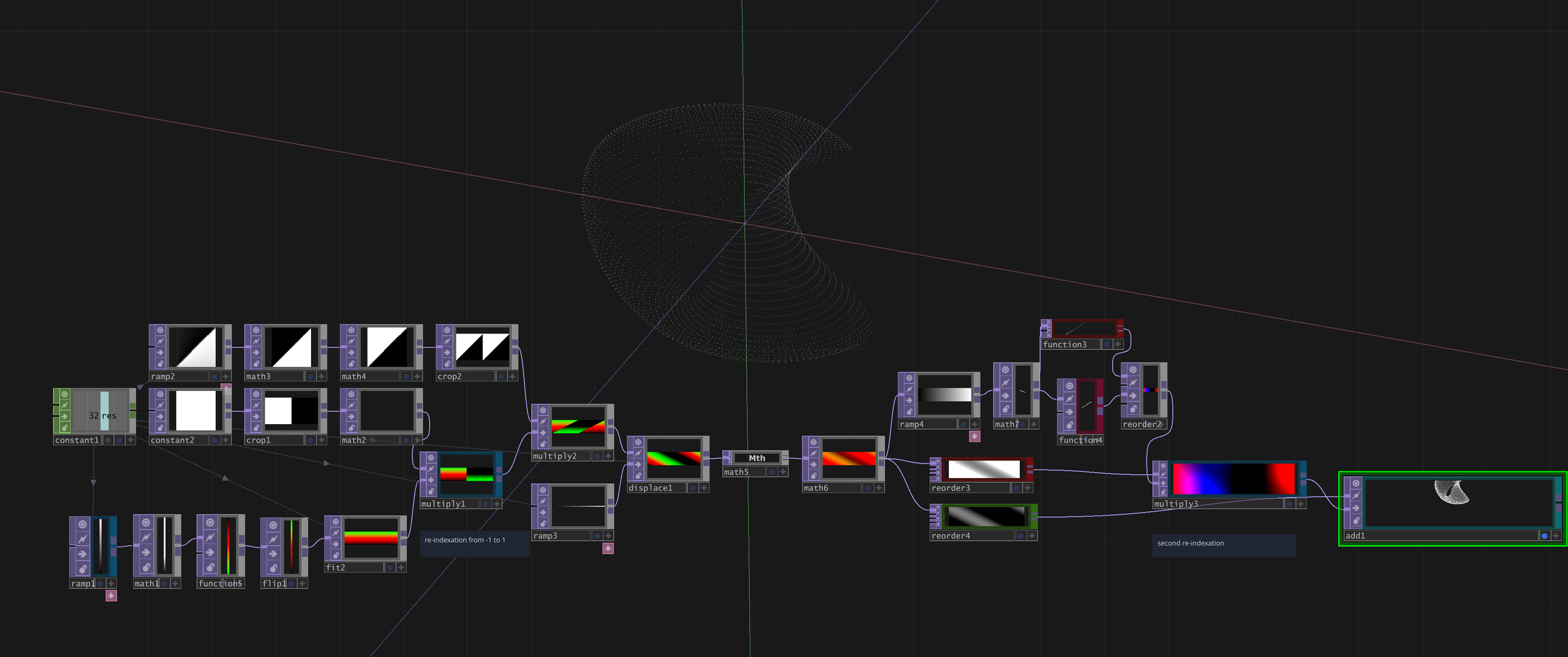
Each point is assigned its own index (here ranging from 0 to 32), although the total number of points is not essential for the construction.
Initially, the line functioning as an analogue of “discourse” in the present visualization is prepared for closure, transformed into a semicircle while preserving the order of the signifiers. From a topological standpoint, no transformation occurs at this stage, since a line with a given number of points is homeomorphic to a semicircle with the same number of points. This establishes the base geometry through the possibility of unfolding a discourse addressed to the Other (meaning the speech of the analysand). The crucial point lies in preserving the index of each point (signifier), which corresponds to the structure of discourse as such: only when its grammar (its indices) is maintained can the chain be sustained. In other words, transformation is possible only insofar as each element retains its place within the chain, even if its “sign” or “orientation” changes. (This concerns the chain of signifiers as an effect of splitting and of the subject, rather than the repetitive circulation of narrative that produces surplus enjoyment, +j.)
In the unfolded line (speech), each point (the equivalent of a signifier) is then subjected to multiplication by negative one. In the Cartesian plane, the operation x → −x, y → −y is not a rotation in space in the intuitive sense, but a central symmetry with respect to the origin. It is not a reflection across an axis; it is the simultaneous change of sign of all coordinates. If a point is given as a vector p = (x, y), then −p = (−x, −y). Geometrically, this means that each point moves to the diametrically opposite point on the circle. Analytically, this corresponds to the moment at which the subject ceases to eliminate excess in favor of the signifier and instead maintains the split as the addition of an opposite index. The subject still addresses its speech to the Other, as though something could be clarified or completed, which is equivalent to a situation in which a point acquires two indices while the structure remains orientable. The split remains content-based rather than formal, without producing a topological effect of irreversibility. (In the mathematical construction, performing this operation once yields a circle, or ring, each point of which carries two indices.)
The second “pass” is applied to the operation of re-indexation itself. As long as re-indexation can function as the addition of yet another index, the system remains orientable. Repetition drives this logic to its limit, and the split ceases to be localized in individual signifiers; it emerges instead as a property of the trajectory as a whole. In other words, the stable surplus shifts from the level of content-based splitting to the level of the operation itself.
In the analytic operation, this corresponds to the emergence of “structural knowledge” that the split cannot be eliminated. A single pass of the operation across all the signifiers that determine the subject is sufficient to reveal the split, but insufficient to sustain it. Attempts to receive a symbolic place from the Other at the moment of “the splitting of the split itself” are exhausted, and the split becomes a form, a global property of the trajectory rather than a feature of content. At this point, the subject can no longer unfold together with discourse in such a way as to situate itself on one side or the other, because difference is no longer contingent or erroneous; it is structurally maintained and becomes irreversible. The gap becomes integrable, and the topology is considered transformed. (In this process, repetition either drives this logic to the exhaustion of addressing, or in some cases allows it to be resolved through the “signifier of the mechanism,” whose own split can perform the same function. In both cases, what is at stake is a change in the regime of retention rather than an event.)
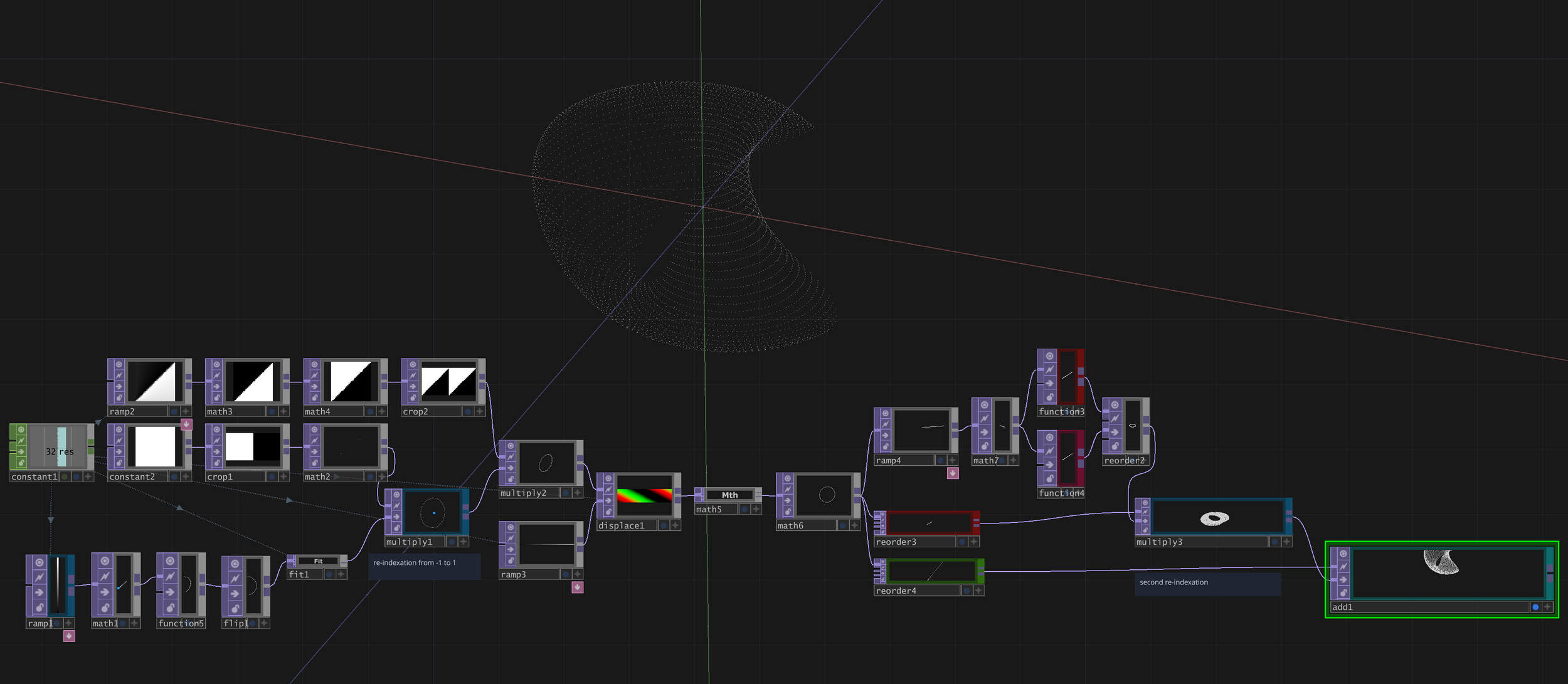
First pass = local splitting (each signifier receives a double index, but the system remains orientable)
Second pass = the splitting of splitting itself (re-indexing is applied to the operation of re-indexing; the system irreversibly loses orientability).
Just as, after the Cartesian formalization, it becomes impossible to fully dissolve the split in favor of a coherent narrative, so after the topological shift it becomes impossible to return to the prior homeomorphism class. The operator continues to maintain the split not by effort but structurally, through the property of the Möbius strip itself.
Clinically, a complete re-indexing of all signifiers is not required for the topological shift to occur (here we may again invoke the notion of approximating a function through the working-through of its principal nodes). It is sufficient for the gap to become retroactively distinguishable and sustainable, after which integration continues to operate autonomously.
For this reason, self-analysis, despite its capacity to produce local differences in the chain, cannot alter the point of address, because the subject remains coincident with the place from which it addresses itself. The analyst is necessary insofar as he does not occupy the place of an Other who confirms or restores the habitual position. The sustained empty place functions here as the absence of support for identification, something structurally impossible in an “internal monologue.”
At the limit of the psychoanalytic operation, the transformed operational topology of the subject coincides with the function of sustaining difference and, in this sense, ceases to be a bearer of meaning or identity. With the splitting of the signifier that guarantees the Law, in the case of partial foreclosure of the Name-of-the-Father, integration of the gap becomes structurally necessary, and the subject is compelled to “invent its own Law,” which makes it possible to sustain the structure of the next topological order. Such integration can no longer be institutionally guaranteed, and the operational regime is introduced as the only possible one.
—
Any psychoanalytic concept may be read as a local regime of handling surplus rather than as an ontological entity. Difference as such does not require a subject-agent and can be described independently of one, whereas splitting designates the impossibility of the subject coinciding with itself, and the gap indicates a transformation of topology itself.
The formalization proposed here does not eliminate the possibility of further transformations; on the contrary, it makes them necessary. Any sustained difference, given sufficient repetition, will sooner or later be integrated. What follows cannot be predicted and cannot be reduced to a radicalization of content; it is possible only as a modification of the mechanism of repetition itself, since repetition is the condition both for the disclosure of the gap and for its loss. Formalization does not guarantee any specific future, but makes the structure of what has already taken place visible.